Sonntag, 7. August 2016

flying for life...

    ...is MAF's slogan and this pretty much sums up our purpose and vision.

"Sharing God's love through aviation and technology to see isolated people physically and spiritually transformed in Christ's name"

    And here are a few facts about MAF. MAF operates 135 aircraft in 26 countries and serves another 11 countries in a non-flying way. Every 4 minutes a MAF plane takes off or lands. There are more than 1300 staff serving and around 1500 organizations being served and the approximately 1500 destinations make clear, we are not the average airline...

    But MAF in Timor-Leste is much smaller. We have 3 pilots and one national staff operating 2 GA-8 Airvans. One of our main task (40-50%) is flying patients from the districts to the national hospital. The so-called Medevacs (Medical-Evacuation) are partially funded by the ministry of health and the rest is subsidized by MAF. The numerous NGO's and private charters form the other half...


  ...so how does my, (Daniel's) day look like? It all depends on our customers. If they request a "first light" departure I have to go out of bed well before 5am but thankfully most people like to be fast asleep at that time... I usually have to get up 2 hours before the plane's departure time, 1 hour to prepare me and another one for the airplane ;-)
It takes me around 10 minutes to get to the airport depending on the route, traffic and personal fitness.
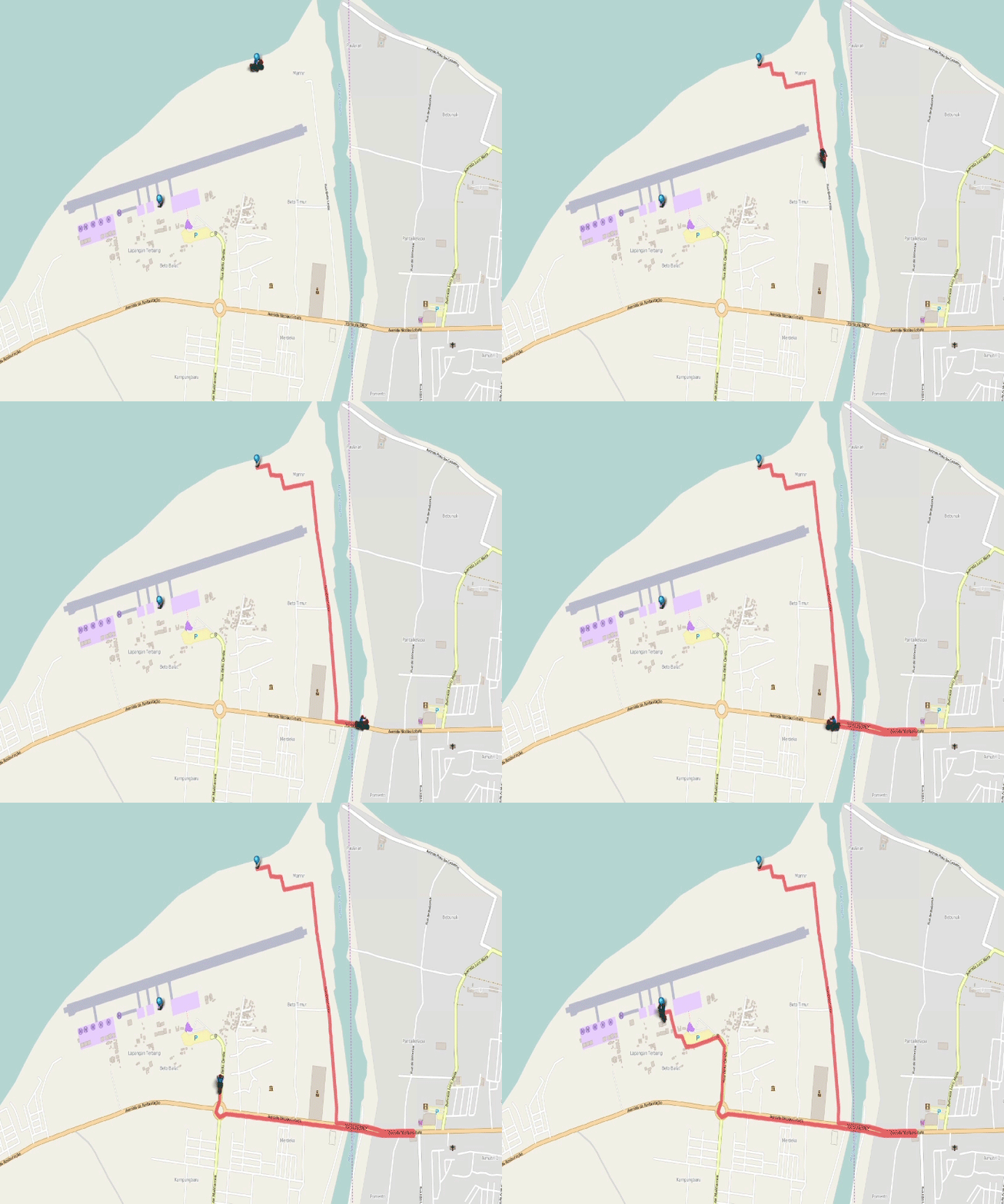

The "official" Route
The "backyard" Route
The "unofficial" one --- caution landing aircraft!
     Once I'm at the airport I've to start 'daily' the plane which basically means making sure that the plane is fit to fly. Then comes the boring part, submitting flight-plan, printing out the forecast weather (which is an educated guess at best), calculating the weight and balance, briefing the passengers and loading their luggage.
    As soon as all of that's done I can jump in and get the start clearance from the Tower and off we go... 

Based in Dili, flying to 8 Airstrips in the Districts
The one and only
"Presidente Nicolau Lobato International Airport"
Atauro Island, 25Km north of Dili
flight time 15'
Los Palos, people use it as a road,
buffaloes and horses use it for grazing
flight time 45'
Maliana, goats and cattle common, sometimes kids play soccer
flight time 25'
Oecussi, old is gone, new is under construction
and landing on the temporary one
flight time 45'
Same, another shared Runway
flight time 25'
Suai, at the moment only for emergency use, until next months,
or the one after...

flight time 30'
Baucau, our longest and highest
used by the Indonesian army, then UN

flight time 30'
most recent reopened, 27th Nov 2015
flight time 30', by road 7 h+
     As you can see from the flight times, all of our flights are well under one hour but it takes many hours to travel there by road. Critical patients often don't have that much time left and are totally in the hands of a team planning their medical evacuation by air. It is a huge privilege to be a part of that team but it also brings some big challenges with it (But more of that will follow on a separate Blog).
   Thankfully not all of our flights are about life and death. A good amount goes toward development. Bringing water experts, teachers and other assessment teams into the Districts. Even prolonged flights with businessmen which are looking for investment possibilities around Timor-Leste are part of what we do. 


   Bellow is a short clip about me driving to the airport. I hope you don't mind the bumpy ride...


Dienstag, 5. Juli 2016

one in between

    A Blog entrance I mean... I was just finishing one about a normal day as a MAF-Pilot but got beautifully interrupted by my parents and sister. They visited us for 3½ weeks and we had a fabulous time together. 

    A famous Swiss singer, songwriter once sang, "everyone needs his island..." but he forgot to mention that every now and then everyone needs a break from his island... And since it is quite expensive to travel to Australia, we were 'forced' to hop a couple islands to the west till we arrived on one called Bali. And you can trust me, it's not as bad as people say it is. You get a lot of good food for not much money and same goes for accommodation but after a few days you get used to it... ;-) People are friendly sometimes a bit pushy but hey by the end of the day everyone needs to bring home a few bucks. The scenery outside the crammed city is wonderful but lets the pictures talk now...

Reunion, Sister came from Madagascar and parents from Switzerland
If people hear of Bali, they think of that...
...and that...
...so we did that


...and that...
...No clue why we did that, 95% of surfing consists
out of waiting and the other 5% drinking salt water

Monkeys are sacred
Not to my Dad
Markets are busy and colorful
and so are the roads

the scenery is stunning
especially around the Uluwatu Temple

more than 80% are Hindu's...

...Sunset doesn't care, it shines for everyone :-)

the Ladies in front of our Hotel, the "Surfer Bliss..." my recommendation

our driver GD, friendly and helpful if you're
ever in need of a Bali-Driver
call him 082341340152

last Bali picture, Luwak-coffee most expensive coffee in the world...
google it, it's gross
    This pretty much summed up our holiday in Bali. We had a great time together and even met some of our church friends which were passing through from Papua, Indonesia.
    
    But after 6 days it was time for us to hop back to our Island which we now call home. It was great introducing our family to Timor-Leste. It's not as fancy as Bali and things are running in a different pace. As westerner patience gets tested and the quality standard is nowhere close to ours but once you get passed those differences, a whole new world opens up. Unlike Bali, It doesn't have 4000+ trip-advisor attractions, it only has 31 and that was exactly what we needed. An empty agenda and loads of Family-time...


Dili's apron, If you are looking for a gate, don't, you won't find one.
Time to relax
and dodge crocodiles (just kidding they live a few miles down and up)
Eating like the Timorese, turns out they were not just serving chicken and fish
The dogs refused to eat one particular leftover piece... :-/
BBQ Swiss style with proper beef
taking advantage of Dad, replacing a section of our roof
I know, our Suzuki Jimny is a beast...
Deb took Family to Hera, her work place...
...short prayer and a couple of songs before the school starts
Sunday excursion with PNG-Missionary couple Mike&Mangen Kaire
Monday excursion to Atauro Island, thanks to the plane a short journey
The package came with a private beach...
don't get too jealous, beach was full of sand fleas ;-)
and coconut à la discrétion
The short scenic detour on the way back to Dili 
marked the end of a great time.
     At the moment we are still waiting for a decision from management about our future. But as long as we are here all of our friends are welcome. We might not have weeks of vacation but sure enough a couple days off to spend time with you. We also can't provide high-end luxury suits but certainly find a nice eco-stay, which is trendy at the moment anyway :-) 

Sonntag, 27. März 2016

The Legend and History of Timor Leste


"The Crocodile legend from East Timor" by
Alexandra Agostinho da Silva


   If you would ask a Timorese about the Legend on how their Land came about they would probably tell you something like this:


Many years ago a small crocodile lived in a swamp in a far away place. He dreamed of becoming a big crocodile but, as food was scarce, he became weak and grew sadder and sadder.
He left for the open sea, to find food and realise his dream, but the day became increasingly hot and he was still far from the seashore. The little crocodile – rapidly drying out and now in desperation – lay down to die.
A small boy took pity on the stranded crocodile and carried him to the sea. The crocodile, instantly revived, was grateful. “Little boy”, he said, “you have saved my life. If I can ever help you in any way, please call me. I will be at your command…”
A few years later, the boy called the crocodile, who was now big and strong. “Brother Crocodile”, he said, “I too have a dream. I want to see the world”.
“Climb on my back,” said the crocodile, “and tell me, which way do you want to go?”
“Follow the sun”, said the boy.
The crocodile set off for the east, and they traveled the oceans for years, until one day the crocodile said to the boy, “Brother, we have travelled for a long time. But now the time has come for me to die. In memory of your kindness, I will turn myself into a beautiful island, where you and your children can live until the sun sinks in the sea.”
As the crocodile died, he grew and grew, and his rigid back became the mountains and his scales the hills of Timor.
Now when the people of East Timor swim in the ocean, they enter the water saying “Don’t eat me crocodile, I am your relative”.


   Up to this day, many people still belief that the crocodile is part of their relatives. So if you jump into the sea, which happens, and you get eaten/bitten by one, which also happens, you must be bad because your relative would never hurt you if you were good...

If you are blessed with a good imagination, "the crocodile"


  History was never my favorite subject but it often plays a vital role when it comes to understanding a culture. So does geography and that's where I want to start.  

map from
http://www.freeworldmaps.net/asia/easttimor/map.html


   The island of Timor is located towards the eastern end of the Indonesian island chain running from Malaya through Sumatra and Java, New Guinea. The island is divided into two parts. Most of the western half remains part of Indonesia. The eastern half forms the largest part of the national territory of Timor, with its capital, Dili, on the north coast, a small enclave on the western half around the city of Oecussi and Atauro small island, 30 km north of Dili. Much of the country is mountainous, and its highest point is Tatamailau or Mount Ramelau at 2,963 meters . 
   The climate is tropical and generally hot and humid. It is characterized by distinct rainy and dry seasons.It has a total area of 15'874 sq/km and as of June 2015 a population of 1.2 Millions+. Average age is 18, 40% of the population is under 15 and 60% under 25 years old. The majority of the people are Catholics (app. 97%), Protestant/Evangelical (2%), Muslim (0.3%) form the minority and there is a good amount of animism mixed and hard rooted into all religions mentioned above.
   Tetum is the official language but schools and government mostly uses Portuguese books. The majority of people are able to speak Bahasa/Indonesian and some understand English. But if you travel around Timor you will notice that there are 8 other indigenous languages. Deb and I are still at the very beginning with our Tetum and we are suppose to start a language training soonisch... ;-)
   As far as economy goes, the country relies heavily on crud petroleum and coffee. The 2 offshore oil fields, located in the Timor Sea, are already more than 70% extracted of oil and gas reserves. In addition to that came the unexpected oil price drop of 45% in 2014. This leads Timor-Leste to a very challenging future with a lot of young people but not much employment or education opportunities.


http://atlas.media.mit.edu/en/profile/country/tls/
 
  Now to the boring part, history. You will find a much more indept report on wikipedia but I will do my best to keep it short here. 

  Portuguese settle in - Not much is known of Timor before 1500
AD. Portuguese traders arrived between 1509 and 1511, and in 1556 a handful of missionaries established the first Portuguese settlement in the Oecussi enclave.

  World War II - The Allies were engaged in heavy fighting with the Japanese forces in Timor. They received support from locals, for whom the cost was tremendous. Several thousand East Timorese lost their lives fighting alongside the Allies. The Japanese defeated the Allies in February 1942 and controlled Timor until Portuguese rule was restored in Timor-Leste in 1945.

  Portuguese pull out and Indonesia invades -  Following a coup in April 1974, Portugal set about discarding its colonial empire. Within a few weeks, political parties had been formed in East Timor, and the Timorese Democratic Union attempted to seize power in August 1975. A brief civil war saw its rival Fretilin come out on top, declaring the independent existence of the Democratic Republic of East Timor on 28 November.
But Indonesia opposed the formation of an independent East Timor, and on 7 December launched its attack on Dili. By 1976 there were 35,000 Indonesian troops in East Timor. The cost of the brutal takeover to the East Timorese was huge; it's estimated that at least 100, 000 died in the hostilities, and ensuing disease and famine.
By 1989, Indonesia had things firmly under control and opened East Timor to tourism. Then, on 12 November 1991 Indonesian troops fired on protesters gathered at the Santa Cruz Cemetery in Dili to commemorate the killing of an independence activist. With the event captured on film and aired around the world, the embarrassed Indonesian government admitted to 19 killings, although it's estimated that over 200 died in the massacre.
While Indonesia introduced a civilian administration, the military remained in control. Aided by secret police and civilian Timorese militia to crush dissent, reports of arrest, torture and murder were numerous.

  Independence - Timorese hopes for independence remained high, but Indonesia showed no signs of making concessions until the fall of the Soeharto regime. Shortly after taking office in May 1998, Soeharto's successor, President Habibie, unexpectedly announced a referendum for East Timorese autonomy. On 30 August 1999, East Timor voted overwhelmingly (78.5%) for independence from, rather than autonomy within, Indonesia. Though the Indonesian government promised to respect the results of the UN-sponsored vote, military-backed Timorese militias massacred, burnt and looted the country.
International condemnation led to UN troops bringing peace to East Timor beginning in September 1999. Half a million people had been displaced, and telecommunications, power installations, bridges, government buildings, shops and houses were destroyed. Today these scars are everywhere.
The UN set up a temporary administration during the transition to independence, and aid and foreign workers flooded into the country. As well as physically rebuilding the country, East Timor has had to create a civil service, police, judiciary, education, health system and so on, with staff recruited and trained from scratch.
The UN handed over government to East Timor on 20 May 2002. Fretilin military leader Xanana Gusmão was president of the new nation, and Fretilin leader Mari Alkatiri was prime minister.


   I hope that this blog delivered some background information. I promise to bring more pictures and personal insight in future blogs but I belief this was necessary to understand the bigger picture...